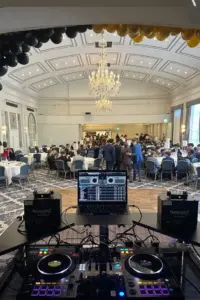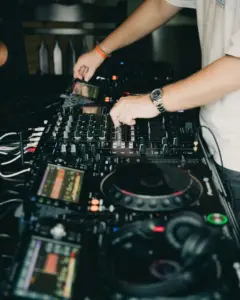
The best compliment a DJ can earn is that nobody talks about the DJ. At a great party, no one says, “That transition was flawless.” They say the night flew by, the dance floor never emptied, and even Grandpa found a song worth dancing to. That is what makes judging a DJ so tricky: when everything works, almost none of the work is visible.
This guide pulls back the curtain. It explains what makes a good DJ in practical terms: the nine skills that matter, what each one looks like from a guest’s seat, and four simple tests you can run before you sign anything. Our private event DJ service in Miami at DJ Duni Entertainment has more than 25 years behind the booth, and this is how we think about the job.
The Short Answer
So, what makes a good DJ? A good DJ plans the night with you before it happens, moves between songs without letting the floor stall, adjusts to the crowd, speaks clearly on the microphone, sets the volume for each part of the event, keeps the timeline moving, stays calm when something breaks, and is easy for everyone else on the team to work with. Music taste matters, but it is the entry ticket, not the whole job.

Here is each skill at a glance.
| Skill | When it is working | When it is missing |
| Preparation | The DJ already knows your guest mix, key moments, and must-play and do-not-play songs | You get a generic form and a “just send a playlist” |
| Transitions | One song flows into the next and the beat never wobbles | Dead air, sudden volume jumps, clashing beats |
| Library and sequencing | Every generation hears something familiar, in a sensible order | The same ten hits, or a set built around the DJ’s own taste |
| Reading the room | The DJ shifts style at the first sign of drift | The floor empties and the playlist carries on |
| Microphone work | Short, warm announcements and names said correctly | Rambling, mumbling, or talking over songs |
| Sound control | Dinner is comfortable, speeches are clear, the dance floor feels full | A loud dinner and feedback during toasts |
| Cue discipline | Entrances, toasts, and dances start on the planner’s signal | Guests waiting and photographers missing moments |
| Problem-solving | A dead microphone or tripped breaker is fixed before most guests notice | The party stops while someone hunts for a cable |
| Easy to work with | Planners, photographers, and venue staff are glad to see the DJ arrive | Friction with the team and the venue |
Preparation: Good DJs Start Working Before the Party
You can spot a good DJ in the very first conversation. A good DJ asks questions. How old is your guest list? Which languages will people speak? Which songs must be played, and which must never be played? Who is giving toasts? Which moments need one specific song? A weaker DJ asks for a playlist link and a deposit.
Those questions matter because they replace guessing with information. Tell a DJ that your father wants one bolero and your cousins want reggaeton until closing, and the night can be built around real people instead of an imaginary average crowd. A Miami guest list can easily span three generations and two languages, which makes this stage the place where a good DJ earns the right to take musical risks later.
Look for a DJ who expects at least one planning conversation, writes the key moments into a run sheet, and asks you to confirm how names are pronounced. Some of our clients mention in their reviews that we went over the schedule with them before the day. That is deliberate. The schedule is where good music and good timing meet.
2. Transitions: Songs That Flow Without Anyone Noticing
Mixing is the most technical skill in DJing and one of the easiest to judge by ear. The test is simple: can you tell exactly when one song ended and the next began? If you cannot, the DJ is doing the job.
Here is what happens in the half minute before a song change. The DJ has already picked the next track and is listening to it privately in headphones, setting the exact point where it will start. They match its tempo to the song that is playing, by ear, with the controller’s sync tools, or both. They adjust the bass so two low-end sounds do not pile up and make the speakers muddy. Then they launch the new song exactly on a phrase boundary, the point where the music naturally turns over, which in most dance tracks comes every eight bars (32 beats). The ear expects a change there, so the blend feels natural. Done well, the dance floor hears one continuous song.
Skill also shows in knowing when not to blend. A first dance, a toast, and a grand entrance each need a clean start, not a crossfade. A good DJ treats transitions as tools and picks the right one for the moment: a smooth blend for the dance floor, a gentle fade for dinner, a sharp cut for an announcement.
The warning signs are easy to hear: silence between songs, sudden jumps in volume, two beats fighting each other, or songs chopped off mid-chorus because the DJ is rushing.
3. Library and Sequencing: A Night Is a Shape, Not a List
Access to millions of songs is easy now. Knowing which five songs from a decade reach the widest group of people is the part that takes years.
Versions matter more than most hosts realize. The original, the radio edit, a remix, and a clean version of the same song can feel completely different on a dance floor, and a family party with kids and grandparents may need clean edits. A good DJ keeps these options ready and chooses the one that fits the room.
Sequencing is the other half. Energy climbs, holds, dips, and climbs again, and the order of the songs draws that curve. Good DJs use bridge songs, tracks that share a tempo or a vocal feel with two different styles, to move a room from salsa to pop or from bachata to hip-hop without making anyone feel dragged along. On a Miami dance floor that holds guests who grew up on classic salsa and guests who grew up on today’s reggaeton, that skill keeps everyone moving.
4. Reading the Room: Spotting the Signals, Then Choosing a Move
Every DJ claims to read the crowd. What matters is what they look at and what they do next.
A good DJ watches for specific signals. Who is dancing, and which generation just left the floor? Are the edges of the dance floor filling up or thinning out? Are phones coming out to film, which usually means a song is landing? Is a line forming at the bar after a high-energy block, which is normal, or is a group drifting toward the patio, which is not? The DJ also watches the hosts. A glance at the couple’s table or the birthday guest’s face tells more than any request list.
Then comes a choice among three moves. The DJ can hold, staying in one style while the floor builds. They can bridge, shifting toward a new style with a song that belongs to both. Or they can reset, returning to a song nearly everyone knows and building the energy back up. The move weaker DJs make is a fourth one: doing nothing and hoping the next song fixes it.
Reading a room is partly a speed skill. The earlier a signal is spotted, a few guests drifting instead of a whole table leaving, the smaller the correction needs to be.
5. Microphone Work: The MC Side of the Job
At many events the DJ is also the host, and the microphone is where plenty of talented DJs lose points. A strong MC is clear, warm, and brief. Announcements should be short enough that the song that follows still feels like the main event.
Names come first. Mispronouncing a grandmother’s name or a company founder’s name in front of 150 people is a mistake nobody forgets, so a good DJ asks for phonetic spellings ahead of time and checks them again before the introductions.
Language matters too. Celebrations in Miami often move between English and Spanish at the same table, and a toast delivered in only one language leaves part of the family on the outside. A bilingual DJ/MC can open in one language, welcome guests in the other, and keep everyone included. Our DJ/MC is bilingual, so announcements and toasts can move between English and Spanish as the room requires.
Finally, a good MC knows when to stay quiet. Talking over every song, shouting hype lines at a calm dinner crowd, or turning a sentimental first dance into a game show are habits of a DJ who likes the sound of their own voice. The best MC work is mostly invisible: the right sentence at the right time, then back to the music.
6. Sound Control: The Right Volume for Every Part of the Night
A good DJ is not the loudest DJ. A good DJ is the one whose volume matches what the room is doing.
Think of the evening in phases. During the ceremony, the goal is clear speech. During cocktails, music should sit under the conversation. At dinner and during toasts, the room should be comfortable enough that guests at the same table can talk without leaning in. Then the dance floor can open up, because guests have chosen to be there. The National Institute on Deafness and Other Communication Disorders points to about 85 A-weighted decibels (dBA) as the level where sound, heard for a long time or over and over, can start to damage hearing. That is a good reason for a DJ to treat volume as a plan and not an afterthought.
Placement matters as much as power. Speakers aimed at the dance floor and away from dining tables, microphones tested at the exact spot where the best man will stand, and a quick feedback check before guests arrive are signs of a DJ who has done this many times. Coastal conditions add another layer. Humidity and salt air are hard on electronics, which is why we use coastal-grade audio equipment.
7. Cue Discipline: The Stage Manager Behind the Music
Behind every smooth entrance, toast, and cake cutting is a chain of small signals. The photographer needs to be in position. The planner needs to give the green light. The kitchen needs to hold the entrees. The DJ sits at the end of that chain and decides when the music or the microphone starts.
A good DJ treats the timeline like a script. They know the order, the cues, and what depends on what. They confirm who will signal them, they hold an announcement until the room is ready, and they adjust when a speech runs long or dinner service is late. Guests do not see any of this. They simply notice that nothing feels rushed or awkward.
If your event has no planner, the DJ’s role grows. They are often the only person with a view of the whole room, the clock, and the microphone at once. That is why it is worth confirming exactly who is calling each cue before the event, even if the answer is “the DJ.”
8. Problem-Solving: What a Good DJ Does When Something Breaks
Every experienced DJ has a story about a night that did not go to plan. The skill shows in how little the guests notice. Here are five common problems and how a good DJ handles them.
- A wireless microphone cuts out during a toast: The DJ hands the speaker a spare, keeps the room relaxed with a pause or a light remark, and checks batteries and signal afterward.
- A power circuit trips: The DJ keeps audio on its own circuit when the venue allows it, knows who at the venue can reset the breaker, and gets music running again before the silence feels long.
- Rain moves the ceremony indoors: The DJ relocates speakers and microphones quickly, retests levels in the new space, and tells the planner the moment sound is ready.
- A guest hands over a USB drive of “a few songs”: The DJ thanks the guest, checks the songs against the host’s list, and works in what fits instead of saying yes to everything or no to everyone.
- The laptop freezes: A second music source is ready, so the song keeps playing while the main system restarts.
None of these has to become a story when it is handled well. A good DJ does not say “that never happens.” A good DJ has a plan for each one.
9. Easy to Work With: The Skill Planners Remember
The last skill has nothing to do with music. It is how a DJ treats everyone else in the room. A good DJ arrives when promised, loads in without blocking the caterer, follows the venue’s rules on noise and access, and speaks respectfully to the photographer, the coordinator, and the staff. They dress to match the event, take direction from the hosts without arguing, and say no politely when a request would break the flow or the do-not-play list. They keep cables covered and out of walkways, and they can provide a certificate of insurance when a venue asks for one.
This matters more than hosts expect. Planners and venues talk to each other, and the DJs they recommend are the ones who made their jobs easier. Miami venues often have tight load-in windows and firm vendor rules, so a DJ who already knows how to work inside them takes stress off everyone, including you.
Why a Great Club DJ Is Not Always a Great Event DJ
A big name from the club scene can look like a safe bet, but the jobs are different. A club DJ plays for a crowd that came for the music. An event DJ plays for a room that came for the host, and that room may include a ten-year-old, a grandmother, and a CEO.

An event DJ also does things a club set never asks for: running the microphone, following a timeline, testing sound before guests arrive, and keeping the volume comfortable through dinner. When you evaluate a DJ, ask about experience with events like yours, not only how well they play. That question gets closer to what makes a good DJ for a wedding or party than any highlight reel can.
How to Tell If a DJ Is Good: Four Small Tests Before You Book
No technical background is required to check what makes a good DJ. The four tests below take about fifteen minutes in total and cost nothing.
- The Bridge Test: Pick two songs from your list that do not obviously fit together, such as a slow bachata and a pop hit from the 2000s, and ask how the DJ would connect them. A good DJ answers with a concrete idea: a bridge song, a tempo shift, a deliberate pause. A weaker DJ says, “I’ll figure it out on the night.”
- The Name Test: Send the three hardest names on your guest list and ask the DJ to say them back, on a call or in a voice note. You will learn how they handle detail and how they sound on a microphone.
- The Rain-Plan Test: Ask what would happen if rain pushed your ceremony indoors thirty minutes before it starts. A good DJ talks about moving speakers and microphones, retesting levels in the new room, and checking in with the planner. A weaker DJ has never thought about it.
- The Detail Test: Read reviews for specifics. “Great DJ” says little. “Kept the floor full from the first song and switched between English and Spanish for the toasts” says a lot. Look for reviews that describe what the DJ did, not only how the reviewer felt.
For full hiring checklists, see our guides to hiring the right wedding DJ and hiring a private event DJ. For the local angle, read what makes a wedding or event DJ in Miami worth booking.
What “Good” Looks Like at Different Events
The core skills travel from one event to the next. What changes is which ones carry the most weight.
| Event | What the DJ focuses on | The skill that carries the most weight |
| Wedding | Ceremony audio, MC work, a full-day timeline, a dance floor for every age group | Cue discipline and reading the room |
| Corporate event | Background music, clear speeches and awards, a program that runs on time | Sound control and microphone work |
| Private party | A strong opening, personal songs, a guest of honor who sets the tone | Library and sequencing |
At a wedding, ceremony audio, the MC role, and a long timeline make cue discipline and room-reading the heart of the job. A good wedding DJ also protects the quiet moments, so our wedding DJ service in Miami is planned around the full celebration rather than just the dance floor. At a company event, the music mostly stays out of the way, so sound control and microphone work decide how the evening feels, which is how our corporate event DJ service in Miami approaches programs, speeches, and awards.
At birthdays, anniversaries, engagement parties, Sweet 16s, Quinceañeras, retirement parties, graduations, and family reunions, the guest of honor sets the tone and a deep library matters most. Our private event DJ service in Miami is built for exactly those celebrations.
What DJ Duni Brings to the Booth
Twenty-five-plus years and more than 1,175 events have taught us the lessons in this guide, and DJ Duni Entertainment is built around them. Our bilingual DJ/MC hosts in English and Spanish. Each setup comes with an illuminated DJ booth, wireless microphones, and lighting for the dance floor, and we choose coastal-grade equipment that stands up to South Florida’s humidity and salt air. Every package is customized, and every quote is honest about what your day needs and what it does not. If your celebration calls for more than music, we can add LED robots and dancers, uplights, live violin, a quartet or trio, a photobooth, or cold sparklers where the venue permits them.
Frequently Asked Questions
What are the most important qualities of a good DJ?
A good DJ combines nine skills: preparation, smooth transitions, a deep music library, reading the crowd, clear microphone work, sound control, cue discipline, calm problem-solving, and an easy working style. Music taste alone is not enough: plenty of DJs with a great ear stumble on the microphone, the timeline, or the venue’s rules.
How can I tell if a DJ is good before I book?
Run a few quick tests. Ask how they would connect two songs from your list, have them say the hardest names on your guest list out loud, ask what they would do if rain moved your ceremony indoors, and read reviews for details about what the DJ actually did. Pay attention to how many questions they ask you. A good DJ is curious about your event before talking about their own.
Does a good DJ take requests?
Yes, with judgment. A good DJ treats a request as information about the room and works it in when it fits the flow and your do-not-play list. If a song does not fit the moment, they say they will work it in later and then do it, or they decline politely. A DJ who refuses every request is not protecting your night, and a DJ who plays every request does not have a plan.
What is the difference between a DJ and an MC?
The DJ plays and mixes the music. The MC speaks: announcements, introductions, toasts, and cues for the room. At many weddings and private events one person does both, which works well when that person is comfortable on a microphone. Ask whether your DJ also hosts and, if your guests need it, whether they can do so in more than one language. Ours is bilingual in English and Spanish.
Is a more expensive DJ always better?
Not automatically. Price reflects hours, team size, equipment, and extras such as lighting, a photobooth, or live musicians, so two quotes are only comparable when you line up what each one includes. Ask for an itemized quote and compare the skills in this guide. At DJ Duni Entertainment, packages are customized, and the quote you receive is an honest one for the day you describe.
How early should a good DJ arrive to set up?
Early enough to finish setup and a full sound check before the first guest walks in, with extra time for tight load-in windows, a long carry, or a rain plan that moves the ceremony. Ask for the arrival time in writing so there are no surprises.
What should a good DJ ask me before my event?
Expect questions about your guest count and age mix, the languages you want on the microphone, your must-play and do-not-play songs, the key moments of the night (entrances, toasts, and dances), how names are pronounced, and your venue’s rules for sound and load-in. The more specific the questions, the more specific the night.
Ready to Meet a DJ Who Plans the Night With You?
Now you know what makes a good DJ and how to check for it. If you would like to hear how we would handle your guest list, your venue, and your schedule, DJ Duni Entertainment is happy to talk it through.
Start with our private event DJ service in Miami, then reach us at (305) 300-3785 (Monday to Friday, 9:00 AM to 5:00 PM, with weekends by appointment) or booking@djduni.com. Prefer to write? Send your event details through our online inquiry form.