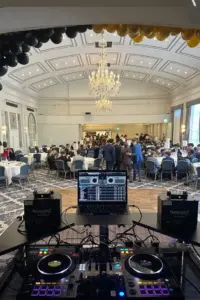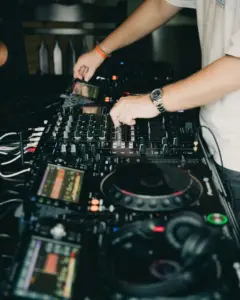
A corporate holiday party DJ in Miami spends the first hour of the job doing something guests never see: learning the room. Where the power outlets sit, how the doors swing, and whether the ceiling is low enough to swallow bass or high enough to scatter it. By the time the first colleague arrives with a drink in hand, a good part of the evening has already been decided.
Holiday parties are an odd assignment. The same crowd needs quiet enough for conversation at 7:00 and loud enough to dance by 9:30, and it has to travel from one to the other without noticing the join. Hotel ballrooms in Brickell and elsewhere add their own puzzles, from strict load-in windows to timelines set by the banquet team.
This guide walks through the pieces of a company party that a DJ shapes, from sound and lighting to screens and the music itself. Plan them as one system, and you avoid booking four separate things that end up fighting each other.

The Hour Nobody Sees
Load-in usually happens while the banquet team is still setting tables, so a DJ works around chair carts and florists. Hotels often assign a load-in window and a specific service elevator. Ask the venue for both before the contract is final. Miss that window and the DJ may get 45 minutes to set up instead of two hours, and rushed setups tend to show in the sound.
Once equipment is in, the DJ walks the room. The goal is a booth position that sits within reach of power, close enough to the dance floor to feel connected, and clear of both the bar line and the sightline to the stage. Speakers go up on stands. Sound aimed at head height reaches the back wall, while sound aimed at the floor gets soaked up by the first few rows of guests.
Then comes the part planners rarely hear about. An empty ballroom echoes. A full one absorbs sound, so a level that felt right at 5:00 p.m. can sound thin by 8:00. A careful DJ trims the system again after the room fills and keeps adjusting all night.
Where the Booth Goes and What It Looks Like
In a ballroom with chandeliers and draped linens, a folding table with a laptop on it looks out of place. Booth design is a small decision that changes how the whole front of the room reads. Options range from a skirted table in the event’s colors to a framed front panel carrying a logo to LED video panels that turn the booth itself into a display. Ask your DJ what is available, what it costs, and how much floor space it needs.
Placement matters as much as design. A booth pushed flat against a wall looks tidy but leaves the dance floor feeling like an afterthought. A booth set at the edge of the floor pulls guests toward it. Leave a few feet of clear space around it for the DJ to move and for cables to run safely, and keep the path to the restrooms and the bar open.
Whatever look you choose, confirm it with the venue early. Some hotels have rules about rigging, floor protection, and what may be attached to walls or ceilings. You want to hear those rules well before setup day.
Light Does Half the Talking
A ballroom lit only by overhead fixtures feels like a conference room, even with excellent music. Colored uplighting along the walls changes the mood within minutes. Moving fixtures on stands near the dance floor add motion once the party warms up. The two do different jobs. Uplights set the tone of the whole room, while moving lights set the energy of one part of it.
Think of the lighting in stages. During cocktails and dinner, soft amber or a muted version of your company color keeps faces warm and the room calm. When speeches start, the lights around the stage brighten, and the dance floor lights go still, so attention has somewhere to land. When the dance floor opens, the lighting shifts character along with the music, with color changes, slow sweeps, and brighter pools.
Those changes feel best when the lights and the music share one set of cues. Ask who controls the lighting. If the DJ runs it, the move from dinner to dancing happens at a single moment. If a separate technician handles it, the two need to rehearse the handoff, or the room can look like it is changing its mind.
Screens: When Visuals Help and When They Compete
Screens have become common at corporate parties, and they can do real work. A company logo with a soft holiday animation on arrival tells guests they are in the right place. A loop of photos from the year gives people something to look at and talk about while the line moves. Motion graphics synced to the music bring the dance floor to life.
They can also compete with the program. A screen full of moving color behind a speaker pulls eyes away from the person talking. A good rule is to switch to a still image, usually the logo or an event title, whenever someone is speaking, then bring the motion back when the music takes over.
Artwork is the usual snag. Visual content needs approval, correct file formats, and time to be tested on the actual display. Ask your DJ for the deadline and the specifications, then send everything a week or two ahead. Check that text is big enough to read from the back of the room and that your brand colors do not clash with the room lighting.

Music Has a Shape
A holiday party has a natural arc, and the music should follow it. Early in the evening, a lounge feel with relaxed tempos and low volume gives colleagues room to talk. During dinner, familiar songs at a conversation level keep the energy steady. As the formal program ends, the tempo creeps up. By the time the dance floor opens, the DJ is ready to move into open-format mixing that covers what a mixed crowd will recognize.
In Miami, that mix often means pop hits, Latin favorites, and older songs that cross generations. The first dance-floor track carries more weight than any other. Pick a song that a 25-year-old and a 55-year-old both know, and the floor tends to fill without any coaxing.
Share a do-not-play list and any content guidelines in advance. Workplace parties usually call for clean versions of songs, and a DJ who knows that before the night starts will not have to guess. Request policy deserves a conversation as well. Some DJs take requests all evening. Others filter them through the host. Decide which suits your group.
The Handoffs: Toasts, Speeches, and the Dinner Bell
Music is the visible half of the job. The other half is the microphone. A holiday party often includes a welcome from a senior partner, a toast, a few thank-yous, and maybe an award or two. Each one needs a working mic and a clean cue.
Test every wireless microphone during the sound check, including the spare, and replace batteries before the doors open. Decide who holds which mic and where speakers will stand, because standing next to a loudspeaker is the classic recipe for feedback. When someone starts talking, the DJ lowers the music underneath and brings it back afterward.
Write the cues down. “Dinner is served” might come from the banquet captain, the toast from an executive assistant and the dance floor opening from the DJ. When everyone knows who signals what, the evening moves without long pauses or people talking over each other.
Making It Feel Like Your Party
Holiday parties tend to blur together, and small details make yours feel specific. A walk-up song for each team that finished a big project. A playlist built from songs staff submitted. A short shout-out to the department that stayed late all year. If the company supports a local cause, a line from the host about where donations go.
None of this needs a large budget. It needs information. A short form to the host that asks for company colors, key names, inside jokes that are safe to use, and the one song that always gets the office moving will give the DJ plenty to work with. Ask for the pronunciation of any names that will be announced. It takes two minutes and prevents an awkward moment at the microphone.
A Sample Evening, Hour by Hour
The times below are illustrative. Adjust them to your venue and guest list.
| Time | What the room is doing | Music | Lighting |
| 6:30 p.m. | Doors open, guests arrive | Soft lounge, low volume | Warm wash, logo on screen |
| 7:00 p.m. | Cocktails and networking | Mellow, modern, easy to talk over | Same warm tones |
| 8:00 p.m. | Seated dinner | Familiar songs at background level | Dimmer, focused on tables |
| 8:45 p.m. | Remarks and toast | Music paused or very low | Brighter at the stage, dance floor still |
| 9:15 p.m. | Dance floor opens | Open format: pop, Latin, classics | Moving lights and color changes |
| 10:30 p.m. | Final push | Crowd favorites | Peak energy |
| 11:00 p.m. | Last song, lights up | Closing track | House lights |
Slips That Cost Planners Sleep
A few patterns repeat across company parties:
- Booking lights and screens without telling the DJ, so two vendors compete for the same power and floor space.
- Choosing a dance floor too small for the guest count, or so large that a crowd of 80 looks lost on it.
- Skipping the sound check for the toast microphone.
- Sending artwork for the screen the day before the event.
- Forgetting to ask the venue about load-in windows and rules.
- Leaving the run-of-show vague, so nobody knows who gives which cue.
Every one of these is cheap to fix a month out and expensive to fix an hour before doors.
Booking Notes for Miami Holiday Season
Venues and DJs both fill quickly in December, and Miami’s busy season runs from late fall through spring. Start conversations as soon as the date and venue are set. Bring your run-of-show, guest count, and any lighting or screen plans to the first call, and ask for an itemized quote so you can compare vendors on equal terms.
Planning Your Holiday Party With DJ Duni Entertainment
DJ Duni Entertainment is happy to talk through a holiday party plan with you, from the room layout to the music arc. Our corporate event DJ service in Miami, FL, page explains how we work with company events. To check a date, email booking@djduni.com or call +1 305-300-3785.
Finding a corporate holiday party DJ in Miami that teams will talk about on Monday morning starts with treating sound, light, and music as one plan. Ask the questions early and the evening takes care of itself.
Frequently Asked Questions
How much does a corporate holiday party DJ cost in Miami?
Pricing depends on hours, room size, equipment, lighting, screens, and whether the DJ also acts as emcee. Ask for an itemized written quote so you can compare like with like.
How early should I book?
As soon as the date and venue are confirmed. December dates go first, and Miami’s busy season stretches from late fall through spring.
Does the DJ need to visit the venue first?
A visit helps, and a floor plan with power and load-in details is the minimum. Either way, the DJ should know the load-in window, the rules for equipment, and the room layout before the event.
Can a DJ provide lighting and screens?
Some can, and some work with partners. Ask what is included, what costs extra and who controls the lights during the evening.
How loud should music be during dinner?
Quiet enough for a normal conversation across a table. Ask the DJ to check levels once the room is full, since an empty ballroom sounds different.
Can the DJ announce toasts and awards?
Many can. Confirm it in writing and send the pronunciation of every name.
What should I send my DJ before the party?
The guest count, run of show, company colors, any screen artwork, a do-not-play list, and the contact details for your venue coordinator.
How do I contact DJ Duni Entertainment?
Email booking@djduni.com or call +1 305-300-3785 with your date, venue and guest count.